Black London: Two New Books on the Postcolonial British Capital

Marc Matera, Black London: The Imperial Metropolis and Decolonization in the Twentieth Century, Berkeley: University of California Press, 2015, 414 pp., $29.95 / £22.95, ISBN: 9780520284302

Kennetta Hammond Perry, London is the Place for Me: Black Britons, Citizenship and the Politics of Race, New York and Oxford: Oxford University Press, 2016, 336 pp., $49.95 / £22.95, ISBN: 9780190240202

Reviewed by Michael Goebel, Freie Universität Berlin

If there is a specific date on which Britain became “postcolonial,” many would opt for June 22, 1948. On that day, a former Nazi naval vessel that the war’s outcome had Anglicized, now sailing by the name Empire Windrush, docked at Tilbury on the Thames Estuary. It carried around 500 West Indian labor migrants, who in the popular imagination represented the vanguard of larger numbers to come. Among them was a 26-year-old Trinidadian orphan who in London achieved world fame as the “grand master of calypso.” As the young man’s stage name, Lord Kitchener, testified, a good part of this generation of colonial immigrants was infatuated with the British Empire. “My residence is Hampton Court, so London, that’s the place for me,” he hummed in one of his most celebrated songs, first recorded in 1951.
Continue reading

Posted in Reviews | Tagged , , , , , , , , , , , , , , , , , | 1 Comment

Claims of Modernity: The Building of the Ottoman Imperial Bank in Istanbul

Fabian Steininger, Max Planck Institute for Human Development

Servet 1892_2

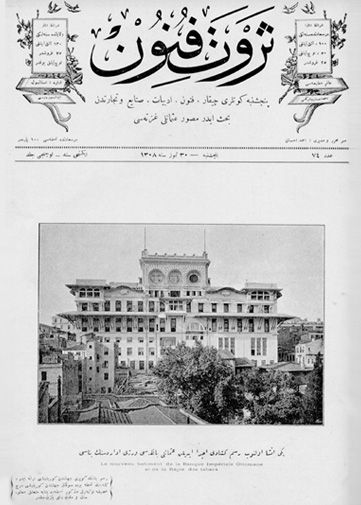
Cover of the journal Servet-i Fünun from August 11, 1892, showing the southern facade of the Ottoman Bank building

In May 1892, the Ottoman state bank (Bank-ı Osmanī-i Şahane) moved into its newly built headquarters in the Voyvoda Caddesi in Istanbul’s Karaköy district. The bank had been founded almost twenty years earlier as a semi-independent institution. Its shareholders were mainly French and English entrepreneurs.

The building of the bank is architectonically remarkable in that it is characterized by two completely different facades. The northern facade facing the street featured the main entrance and was built in the European neo-classical style of the day. The southern facade facing the Golden Horn and the old city could not be seen from the street level but from the water. It was built in a rather different style, which may be called neo-Ottoman or neo-Islamic, and featured eaves and alcoves clearly inspired by early Ottoman architecture. The building, which to this day dominates the view of the Galata peninsula, was designed by the Levantine architect Alexandre Vallaury. Today, it houses a museum of the bank and SALT, a center for research and the arts.

Continue reading

Posted in Article | Tagged , , , , | Leave a comment

The Bloodlands’ City: A New Book on the Making of Ukrainian Lviv

Tarik Cyril Amar, The Paradox of Ukrainian Lviv: A Borderland City between Stalinists, Nazis, and Nationalists, Ithaca, NY: Cornell University Press, 2015, 356 pp., $35.00.

Reviewed by Franziska Davies, Ludwig-Maximilians-Universität München

In the course of the twentieth century the city of Lviv in present-day Ukraine went through virtually all of East Central Europe’s formative experiences: war, post-imperial collapse, competing national projects, Soviet and Nazi occupation, the murder of Eastern coverEuropean Jewry, population exchange and Sovietization. In 1914 Lviv (Polish: Lwów) was a predominantly Polish and Jewish city with a growing and increasingly confident Ukrainian minority and the provincial capital of the Habsburg crownland known as the Kingdom of Galicia and Lodomeria. In 2014 Lviv had been an overwhelmingly Ukrainian city for decades and many of its inhabitants were among those demonstrating for a European orientation of their country on Kyiv’s square of independence. Lviv is often construed as the hotbed of an exclusive Ukrainian ethnic nationalism alien to Ukrainians in the East and ultimately incompatible with their own Soviet past. Not least against this background Tarik Cyril Amar’s study is an important reminder of how much more complex Lviv’s past really is. Lviv’s transformation during the first half of the twentieth century is also the subject of Christoph Mick’s book Lemberg, Lwów, L’viv, 1914-1947: Violence and Ethnicity in a Contested City published in English in 2015. Furthermore, the city is located in what Timothy Snyder has called the Bloodlands, i.e. those places in Europe which were victim of both Stalinist and Nazi aggression from the 1930s until Stalin’s death in 1953. Amar is interested in similar questions, but focuses on the period since the first Soviet invasion in 1939 and on the impacts of Sovietization after the Second World War. Thereby his study offers two important perspectives: Firstly, by looking at the alternation of Soviet and Nazi occupation regimes in one particular city, Amar is able to discuss the question of their interaction more precisely than Snyder’s grand narrative leaves room for. Secondly, by expanding the focus to the 1950s and 1960s the end of Amar’s story does not coincide with the end of mass violence, but also takes the impact of postwar policies into account. His analysis is based on a rich array of sources and secondary literature and considers a wide range of issues such as interethnic relations, social transformation and the remaking of urban living space. Continue reading
Posted in Reviews | Tagged , , , , , , , , , | Leave a comment

Mapping as Process: Food Access in Nineteenth-Century New York

Gergely Baics, Barnard College, Columbia University

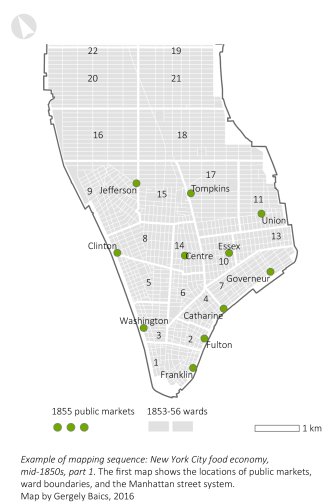
BaicsMapSeq1Geographic information system (GIS) has changed social science and humanities research through spatial analysis. It has reinvigorated the spatial turn, which has swept many fields in the past decades, improving their empirical foundations, methodological tools and analytical process. Historians, especially those working within the field of urban history, have looked to GIS to incorporate new resources and methods to raise new questions or revisit old ones. Further, given the considerable data demands of certain projects, GIS mapping has made historical research more accessible, collaborative and open-ended. Some of the most fruitful collaborations occur when the public is directly invited to help produce and make use of historical GIS data, as is the case with the New York Public Library’s several creative initiatives (Map Warper, Building Inspector, NYC Space/Time Directory), or when historians work together with geospatial analysts to produce innovative scholarship in interdisciplinary centers, such as the Spatial History Project at Stanford University. Continue reading
Posted in Article | Tagged , , , , , , , , , , , | 1 Comment

From Lancashire to the World: The Manchester Ship Canal and Globalization

Harry Stopes, University College London

The ship, prophetic feature of the City Arms, will be no longer a prophecy of what is to be; it will be the symbol of what is, the Port of Manchester, with that other feature of the City Arms, the globe, as representative of the extent of her commerce.”[1]

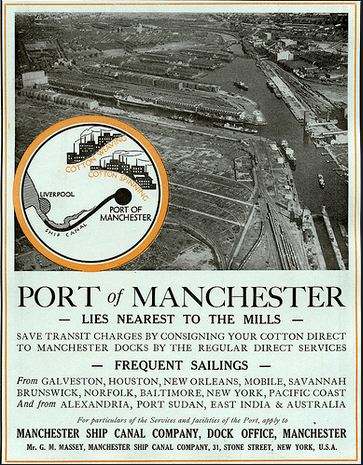
The opening of the Manchester Ship Canal in 1894 was the culmination of a twelve year project which had mobilized mass popular support (a rally of thousands celebrated the passage of a necessary Act of Parliament 3rd October 1885), as well as a significant sum of money (15 million pounds) raised from a mixture of small local investors, large private capital and a loan from the Manchester Corporation. Unlike other nineteenth century British waterways, the Ship Canal was big enough to take modern ocean liners: importers and exporters could now bypass Liverpool docks and sail directly to Manchester, 40 miles inland. Manchester became the fourth biggest port in Britain by value of imports in less than a decade.

1930 US advert for canal

An advert for the canal, for the US market, c. 1930, from the Manchester Libraries, Information and Archives, Manchester City Council

The canal was rationalized as an intervention into the regional economy of the northwest of England, ameliorating the effects of dock and railway rates that canal supporters claimed were prohibitively expensive. New industries were attracted to the area around the docks, particularly to Trafford Park, the world’s first industrial estate, where the Westinghouse Corporation and Ford Motors opened their first European sites in the early twentieth century. But the canal’s function was also symbolic, politically and culturally. To build it was a statement of intent on the part of the city, an assertion of its forward-thinking nature. The campaign to build the canal built upon a populist political rhetoric that brought together workers and industrial capitalists in an alliance of ‘producers’ against supposedly parasitic ‘merchants’ in Liverpool and London. This rhetoric drew upon the symbolism of the anti Corn Law protests of an earlier generation of Mancunians:

“London and large capitalists should not be asked to find the money for us – or they will get in dividends the just fruits of our labour. Let us keep the profit amongst us.”[2]

Continue reading

Posted in Article | Tagged , , , , , , , , , | 3 Comments

Conflict or Brotherhood? Two Studies of Muslim-Jewish Relations in Urban France

Ethan B. Katz, The Burdens of Brotherhood: Jews and Muslims from North Africa to France, Cambridge, Mass./ London: Harvard University Press, 2015, 480 pp, $35.00/ £25.95/ €31.50, ISBN: 9780674088689.

Maud S. Mandel, Muslims and Jews in France: History of a Conflict, Princeton: Princeton University Press, 2014, 272 pp., $35.00/ £24.95, ISBN: 9780691125817.

Reviewed by Laura Wollenweber, Freie Universität Berlin

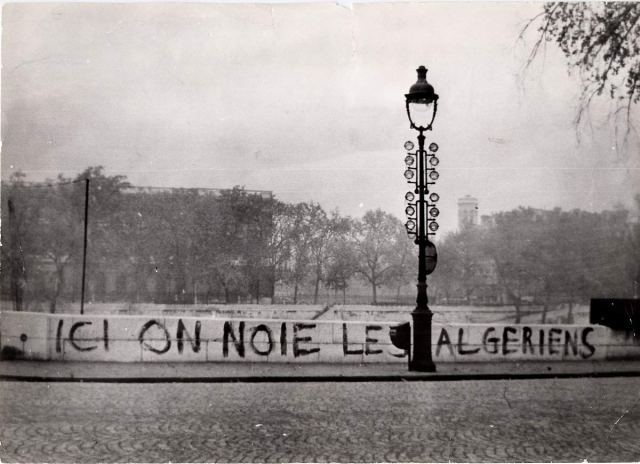
Since the attacks on the Jewish supermarket “Hypercacher” in Paris in January 2015, the tense triangular relation between Jews, Muslims, and France has once more received tragic attention. French cities – which, partially due to the country’s colonial past and postcolonial migration, today hosts the largest Jewish community in Europe – seemingly have become again a place dangerous for Jews to live in. Two recent and very thorough studies – Maud S. Mandel’s Muslims and Jews in France and Ethan Katz’s The Burdens of Brotherhood – shed light on the shared history of Muslims and Jews in France. Both give more complex accounts of their interaction than the mutual hostility portrayed in the news would suggest.

ici on noie

“Here We Drown Algerians” – Painting on a Seine quai after the October 17, 1961, massacre of Algerian demonstrators, which prompted comparisons to the Shoah, Photo of L’Humanité

Continue reading

Posted in Reviews | Tagged , , , , , , , | Leave a comment

Paris Everywhere? The Challenge of Eurocentrism in Global Urban History

Joseph Ben Prestel, Freie Universität Berlin

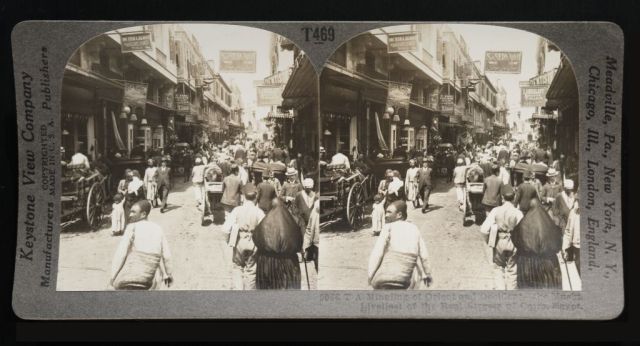
Urban history is becoming increasingly global. Recent trends in historiography, such as transnational and global history, have inspired scholars of urban history who show a renewed interest in questions of comparison and connections. This year’s conference held by the European Association for Urban History in Helsinki offers seven sessions that carry the adjectives “transnational” and “global” in their titles. Another example of the global character of urban history can be found in current media portrayals of the urban past that strive to include cities all around the world. The Guardian‘s The Story of Cities series reflects this tendency. So far the series offers, among other articles, contributions on such diverse places as Barcelona, Beijing, Benin, St. Petersburg, and Potosí. The encyclopedic method of adding histories of different cities is also used in academic literature and can be considered one of the ways in which historians seek to offer a more global portrayal of the urban past. Cumulatively, the contributions to our blog have a similar tendency. What this approach leaves out is the issue of how these different stories relate to each other. When scholars ask, however, how the history of a city like Paris connects to the history of, say, Cairo, they have to face a major challenge of global urban history: Eurocentrism.

Cairo Stereograph 1908

Stereograph from 1908  with the title “Mingling of Orient and Occident — the Muski, Liveliest of the Real Streets of Cairo, Egypt”, from the Travelers in the Middle East Archive: http://scholarship.rice.edu/handle/1911/5570

Continue reading

Posted in Article | Tagged , , , , | 1 Comment

Of Rags and Riches

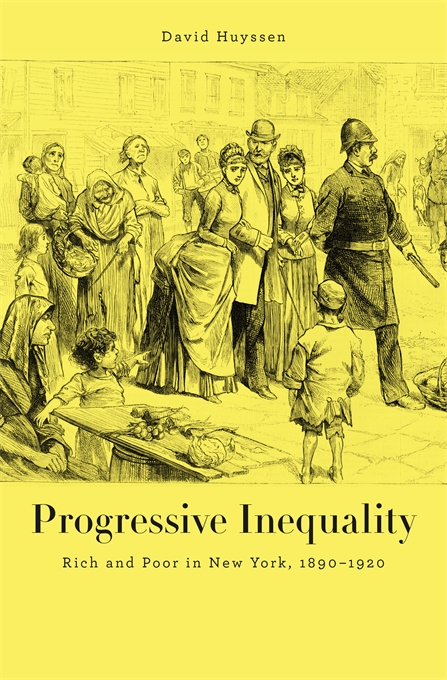
David Huyssen, Progressive Inequality: Rich and Poor in New York, 1890–1920, Cambridge, MA: Harvard University Press 2014, 392 pp, 38,- €, ISBN 978-0674281400.

Reviewed by Björn Blaß, Max Planck Institute for Human Development

“Neither any continental city nor even London has ever had to do anything approaching this in magnitude.” This boisterous remark by Commander Frederick de Latour Booth-Tucker does not only summarize the spectacular Christmas feast held by the Salvation Army that helped 20,000 selected poor New Yorkers to a hot meal, Booth-Tucker’s words also reflect the high-minded hopes and aspirations of those progressive reformers who paid to observe the spectacle from their lodges at Madison Square Garden on Christmas Day 1899. In view of the event Booth Tucker concluded: “It means the dawning of a new era, the bridging of the gulf between the rich and the poor” (2).

Progressive Inequality

Continue reading

Posted in Reviews | Tagged , , | Leave a comment

Vicissitudes of Globality: The Many Connections of Eighteenth-century Charleston

Emma Hart, University of St Andrews

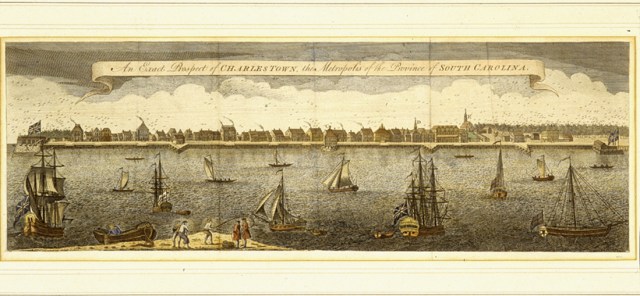
What is the promise of global urban history for the pre-nineteenth-century era? As the vast majority of discussion about cities and “the global” continue to focus on the decades after 1850, I want to return to an earlier time.  Concentrating our attention on Charleston, South Carolina, a city that was the product of early modern Atlantic crossings and circulations, reveals the expansive contexts in which this imperially-driven growth happened.  Charleston’s setting has mostly been labeled as the “Atlantic World,” which was created when European and Africans moved around the Atlantic Ocean and the former claimed territories in the Americas.   While we now have a pretty good grasp of these connections and it is fairly easy for me to describe them, the question of Charleston’s role in a global urban process is much less clear. And, what holds for Charleston, also holds for the other major cities of Britain’s early modern Atlantic world, such as Philadelphia, New York, Boston, and Kingston, Jamaica.  What is more, even the specific role of cities in creating an Atlantic system is often taken for granted by historians, meaning that the urban is not often analyzed very precisely as a historical force, even in an early modern world that often subjugated individual agency to the body corporate.  So, bringing the global AND the urban into focus in a history of Charleston, what new things can we learn about global urban issues before 1800?

Charleston 1762

“An Exact Prospect of Charlestown, the Metropolis of the Province of South Carolina” Bishop Roberts, 1762, from the Gentleman’s Magazine

Continue reading

Posted in Article | Tagged , , , , , , , , , | 1 Comment

When New Orleans Took on New York

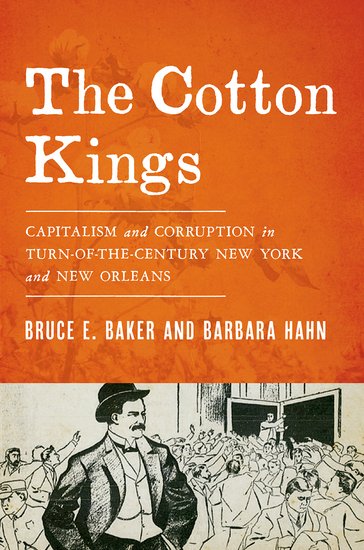
Bruce E. Baker, Barbara Hahn, The Cotton Kings: Capitalism and Corruption in Turn-of-the-Century New York and New Orleans, Oxford/New York: Oxford University Press 2015, 232 pp, £19.99, ISBN 9780190211653.

Reviewed by Catherine Davies, FernUniversität in Hagen

Cotton Kings_CoverIn 1903, the American business journalist Edwin Lefèvre predicted that ‘[t]he history of the bull speculation in cotton of 1903 will never be fully written, because, though the men who influenced it are very interesting, their operations are interwoven with bloodless statistics and tiresome technicalities’ (p. 1). It is, indeed, hard to imagine a history of futures trading entirely devoid of statistics and technicalities. In recent years, however, historians have begun rising to the challenge of writing histories of futures markets that, far from being dry and bloodless, successfully integrate the story of their nature and development into broader legal, economic, political, and cultural contexts. The Cotton Kings, by Bruce E. Baker and Barbara Hahn, which explicitly sets out to prove Lefèvre wrong, is a welcome addition to this small but growing field. Relying on a large amount of primary source material (mostly newspapers and government reports), the authors of this well-researched book reconstruct the history of the market in cotton futures in New Orleans and New York at the turn of the twentieth century. Baker and Hahn narrate their story by combining approaches of ‘business history, southern history, social history, political history, [and] environmental history’ (p. 146). Urban historians will appreciate the occasional foray into the history of New Orleans (New York history, by contrast, is dealt short shrift); overall, though, the immediate physical and material environment of cotton speculation is not the book’s main focus of interest. Transnational and global aspects are acknowledged in the form of brief but incisive sketches of Liverpool’s role in the worldwide cotton trade.

Continue reading

Posted in Reviews | Tagged , , | Leave a comment