Revolutionary Chic: Left-Wing Exiles, Design, and Urbanism in Mexico City

Randal Sheppard, Universität zu Köln
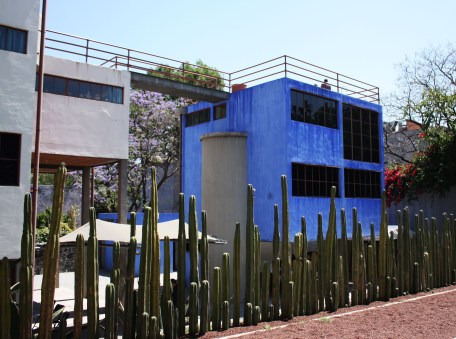
Casa Rivera

Casa Diego Rivera, Mexico City, by Juan O’Gorman, 1931

Mexico City was one of the most important and culturally vibrant hubs of political exile in the Western Hemisphere during the twentieth century. However, the scholarly literature about this phenomenon has so far been limited by disciplinary specialization and a mostly Eurocentric tendency to focus on national communities of exile, particularly Spanish Republicans. Based at the University of Cologne and funded by the European Research Council, the postdoctoral project Left-Wing Exile in Mexico, 1934-1960 aims to produce research that moves beyond such limitations. Lead investigator Aribert Reiman is researching the urban topography of exile in Mexico City in a way that cuts across national communities of exile, while my fellow postdoctoral researcher Elena Díaz Silva is taking a multidisciplinary approach to the study of gender identities and particularly masculinities in exile.
Continue reading

Posted in Article | Tagged , , , , , , | Leave a comment

Historicizing “Urbanity”: Buenos Aires in the epidemic years

Antonio Carbone, Freie Universität Berlin

mnavXX77

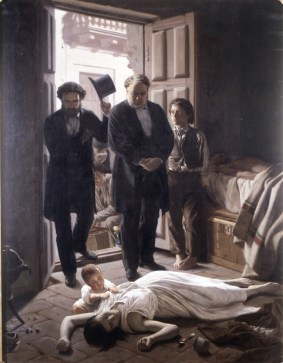
Juan M. Blanes – Un Episodio de la Fiebre Amarilla en Buenos Aires (1871)

Scholars in the field of urban studies have been arguing for decades about what exactly the object of their research could be. At a first glance the ‘urban’ appears as a clearly defined field of research, namely the ‘city’. Nonetheless, upon closer consideration defining what exactly makes up a ‘city’ is a challenging task that has overwhelmed many generations of urban scholars. The intention of creating a unequivocal and ahistorical concept of ‘urbanity’ has probably been one of the main reasons behind these shortcomings. As a contribution to urban studies my research project on Buenos Aires historicizes the concept of ‘urbanity’, showing its historical and hegemonic contingency.

Continue reading

Posted in Article | Tagged , , , , , , | Leave a comment

Buenos Aires and the Modern Girl

Cecilia Tossounian, CONICET (Argentina)

foto blog

“Yesterday and Today,” El Hogar, 14 December 1928, p. 110.

The modern girl, who emerged during the 1920’s and 1930’s, was a global figure that circulated worldwide through commodity and cultural flows. Born and grown in the city, she was an eminently urban phenomenon. In my study of the modern girl figure in Buenos Aires between the two World Wars, I argue that her specific traits can be traced to the back and forth movements between global and local.

The modern girl’s visual similarity across the world was stunning. These young women fashioned themselves as modern by bobbing their hair and using loose-fitting dresses, red lipstick and a cloche hat. They also smoked, drank and danced shimmies with their partners, challenging tradition in each urban scene in which they emerged.

Continue reading

Posted in Article | Tagged , , , , , , | 1 Comment

The Latin Quarter and the Third World

Michael Goebel, Freie Universität Berlin

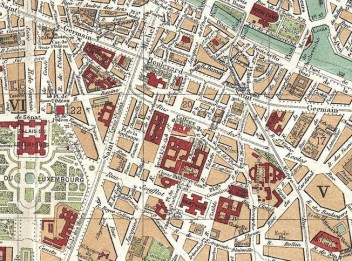
The Latin Quarter on an 1892 map

The Latin Quarter on an 1892 map

Between the two World Wars, imperial centers such as London or Paris became bridgeheads for the spread of nationalism throughout the colonial world. As I argue in my recent book about Paris as an Anti-Imperial Metropolis, migration to European cities politicized many labor migrants, students, and exiles from Africa and Asia because it rendered more palpable the rights differentials that lay at the heart of imperialism. The spatial micro-concentration of places in Paris’s cityscape where the paths of young men from very different countries intersected further intensified this effect. Thus, the later Ho Chi Minh frequented specific Parisian venues, where he met Malagasies and Antilleans, with whom he then founded a communist-sponsored political organization that churned out some of the major anticolonialists of Asia and Africa.

Continue reading

Posted in Article | Tagged , , , , , , , , , | Leave a comment